
Outdoor Security Lighting: A 2026 UK Buyer’s Guide
Table of Contents
- Outdoor Security Lighting Types: Which Fitting Suits Your Property
- Motion Sensor Floodlights: Coverage, Range and False Triggers
- Dusk to Dawn Lighting: Set-and-Forget Security for Drives and Paths
- IP65 Rated Outdoor Lights and Why the Rating Decides Where a Fitting Can Go
- The Best Height for Security Lights (and How to Aim Them)
- Outdoor Security Lighting Installation: What You Can DIY and What Needs a Qualified Electrician
- Frequently Asked Questions
Last Updated: September 30, 2026
Outdoor Security Lighting Types: Which Fitting Suits Your Property
Outdoor security lighting is fixed exterior illumination designed to deter intruders, light pathways and let you see who is at your door after dark. At Ledlam, we supply floodlights, wall lights and bulkhead fittings. Choosing between them comes down to coverage area, mounting position and how exposed the fitting will be.
Floodlights throw a wide, bright beam across driveways, rear gardens and side alleys. They are the workhorse of any outdoor security lighting setup, and most modern versions use LEDs, so they reach full brightness instantly rather than warming up like older halogen units.
Wall lights sit lower and closer to the building, lighting doorways, porches and patios with a softer spread. Bulkhead fittings are the tough option: sealed, compact and usually round or rectangular, they suit outbuildings, sheds and low-level positions where a fitting may take a knock.
Electrical Safety First guidance on outdoor electrical safety
| Fitting | Best Position | Typical Coverage | Suits |
|---|---|---|---|
| Floodlight | High on gable or eaves | Wide, long throw | Driveways, gardens |
| Wall light | 1.8-2.2m on wall | Medium, downward | Porches, patios |
| Bulkhead | Low level or outbuilding | Small, localised | Sheds, side returns |
Motion Sensor Floodlights: Coverage, Range and False Triggers
Motion sensor floodlights switch on automatically when passive infrared (PIR) detects movement, then time out after a set period. The main buying decision is detection range versus false triggers: a sensor set too sensitive will fire every time a cat, a passing car or a swaying branch crosses its path.
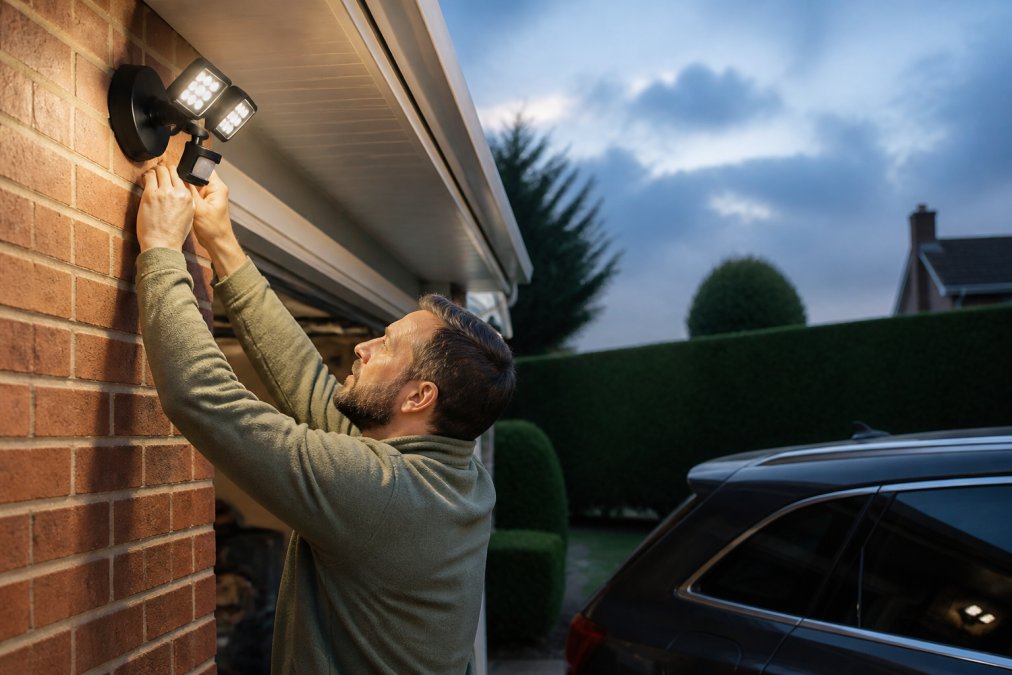
Most PIR sensors detect movement across roughly 8 to 12 metres within a 110-180 degree arc, though exact figures vary by model, so check the specification before buying. Point the sensor slightly downward and away from roads and footpaths to cut nuisance activations.
A common mistake is mounting the floodlight so the sensor faces a heat source, such as a boiler flue or an air conditioning unit. Warm air moving across the sensor reads as movement.
Set the time delay to the shortest setting first, then lengthen it. Most people fit a unit, set it to ten minutes and then wonder why the light stays on long after the postman has gone.
Dusk to Dawn Lighting: Set-and-Forget Security for Drives and Paths
Dusk to dawn lighting uses a built-in photocell to switch on at sunset and off at sunrise, with no sensor and no timer to adjust. It is the simplest form of outdoor security lighting for drives, paths and entrances where you want constant low-level illumination rather than a sudden burst when someone approaches.
The trade-off is energy use. A dusk to dawn fitting runs all night, every night, so LED models make far more sense than halogen. An integrated LED bulkhead or wall light typically draws a fraction of the power of an old filament lamp, and it will not need bulb changes in awkward outdoor positions.
For paths and steps, dusk to dawn lights also reduce trip hazards by keeping the route lit for late arrivals. Combine one at the front of the property with a motion sensor floodlight covering the driveway, and you get both constant visibility and on-demand bright light.
IP65 Rated Outdoor Lights and Why the Rating Decides Where a Fitting Can Go
IP65 rated outdoor lights are sealed against dust and protected against water jets, which makes them suitable for most exposed exterior positions. The IP code has two digits: the first covers solids, the second covers water. A rating of 6 for solids means dust-tight; a rating of 5 for water means protected against low-pressure jets from any direction.
Where the fitting goes decides the minimum rating. A porch light sheltered under a deep canopy may cope with IP44, but anything fully exposed to driving rain, or positioned near a gutter or downpipe, needs IP65 or higher. Fittings installed close to a pond or jet-washed patio should be rated IP66 or above.
Ignoring the IP rating is the fastest way to a failed fitting. Water ingress corrodes the internal electronics, and a unit rated IP44 mounted on an exposed wall can fail within a single winter. Check the rating on the box before you drill any holes.
The Best Height for Security Lights (and How to Aim Them)
The best height for security lights is generally 2.5 to 3 metres for floodlights and around 1.8 to 2.2 metres for wall lights and bulkheads. Mounting too high widens the beam but weakens the light reaching the ground, and it makes the sensor harder to reach for adjustment.
Check out our LED Offers today →
Aim floodlights slightly downward and across the area you want covered, not straight out into the street. Angle the beam so it lights the approach to your door or the middle of the driveway rather than the boundary fence.
For PIR units, walk-test the detection zone after installation. Trigger the light from the furthest point you want it to pick up, then from the pavement, and adjust the sensor head until it responds to the first and ignores the second.
Outdoor Security Lighting Installation: What You Can DIY and What Needs a Qualified Electrician
Outdoor security lighting installation splits into two categories: replacing a like-for-like fitting on an existing circuit, and running new cable or adding a circuit. The first is often within reach of a confident DIYer; the second is notifiable electrical work in most cases and should be handled by a qualified electrician.
In the UK, most electrical installation work in dwellings must comply with Part P of the Building Regulations, and work in certain locations, including outdoors, is notifiable to a registered competent person scheme or your local authority building control. GOV.UK guidance on building regulations approval
Safe practice for any outdoor circuit:
- Use equipment suitable for outdoor use, with the correct IP rating
- Protect the circuit with a residual current device (RCD)
- Terminate cables in a sealed, weatherproof enclosure
- Isolate the supply at the consumer unit before starting work
- Never extend a circuit using indoor-rated cable or connectors
If you are unsure whether a job is notifiable, check with your local authority building control or use an electrician registered with a competent person scheme. NICEIC guidance on finding a registered electrician
At Ledlam, we stock LED floodlights, bulkheads, wall lights and the accessories that go with them. If you are not sure which IP rating or sensor range suits your property, ask us in store or online and we will point you to the right fitting.
Choosing the right outdoor security lighting comes down to matching the fitting to the position, the IP rating to the exposure, and the sensor to the space you want covered. Get those three right and the installation looks after itself for years.
Ledlam stocks LED floodlights, wall lights and bulkhead fittings alongside the weatherproof enclosures, cable and accessories you need to complete the job, all backed by practical advice from our team. Whether you are a homeowner lighting a driveway or an electrician kitting out a rental property, we can help you find the right products at a competitive price. Get started with Ledlam and light your property properly this winter.
Frequently Asked Questions
Do outdoor security lights actually deter burglars?
Lighting removes the cover that intruders rely on, so it works best as part of a layered approach alongside locks, alarms and boundary planting. A fitting that switches on suddenly when someone approaches draws attention to movement in a way a permanently lit lamp does not. The practical aim is to make your property look occupied and awkward to approach unseen, rather than to rely on light alone as a deterrent.
Where should outdoor security lights be positioned?
Cover the routes an intruder would actually use: side gates, back doors, garage doors and dark corridors between buildings. Point fittings across the approach rather than directly at the road, and keep the beam out of neighbouring windows. For motion sensor floodlights, mount them so the detection zone covers the approach path, not just the door itself, and angle the head down so the light lands on the ground where it is useful.
Are LED security lights energy efficient?
LED fittings use a fraction of the power of halogen equivalents for the same brightness, and they last far longer, so you replace bulbs less often. The bigger saving usually comes from how the light is controlled: a 10-watt LED on a motion sensor that runs for a few minutes a night costs very little to run, while an old 300-watt halogen left on all evening adds up quickly. Check the wattage and lumen output on the box before buying.
Do I need an electrician to install outdoor security lights?
Replacing an existing outdoor fitting on the same circuit is usually within reach for a confident DIYer, provided the power is isolated at the consumer unit first. Running a new circuit, adding a fused spur, or working on anything in a special location needs a qualified electrician, and notifiable work must meet the requirements of Part P of the Building Regulations. If you are unsure which category your job falls into, get it checked rather than guessing.