


LED Emergency Lighting: A Practical Guide
Table of Contents
- What LED Emergency Lighting Does and Why It Matters
- Types of LED Emergency Lights: Maintained vs Non-Maintained Emergency Lights
- Key Features to Consider When Choosing LED Emergency Lights
- Emergency Lighting Testing Requirements and Compliance
- Installation and Maintenance of LED Emergency Lights
- Common Issues and Troubleshooting
- Frequently Asked Questions
Last Updated: October 3, 2026
What LED Emergency Lighting Does and Why It Matters
LED emergency lighting is a safety system that automatically switches on when mains power fails, guiding occupants to exits and preventing panic in darkness.
The importance of LED emergency lighting extends beyond legal compliance. In a genuine power outage or fire, these lights become your building’s lifeline. They mark escape routes clearly, help people navigate unfamiliar spaces, and reduce the risk of injury during evacuation.
What makes LED emergency lighting particularly effective is its reliability. Traditional systems often suffered from battery degradation or bulb failure, leaving you unaware until an actual emergency revealed the problem. LED emergency lights offer better visibility, hold their charge longer, and require less frequent maintenance.
At Ledlam, we work with homeowners, electricians, and property managers across the UK who understand that emergency lighting isn’t optional, it’s essential. Whether you’re fitting a single light in a hallway or upgrading a commercial space, choosing the right LED emergency light starts with understanding what’s available and what suits your specific situation.
Types of LED Emergency Lights: Maintained vs Non-Maintained Emergency Lights
Emergency lighting falls into two distinct categories, each designed for different applications. Understanding the difference between maintained and non-maintained emergency lights is crucial to selecting the right system for your building.
Maintained Emergency Lights
A maintained emergency light operates continuously as part of your normal lighting. It draws power from the mains, stays on during the day, and continues operating from its battery when power fails. This dual-mode design means the light is always visible to occupants, reinforcing awareness of exit routes even during normal operations.
Maintained emergency lights are common in environments where continuous visibility is important: hospitals, care homes, secure facilities, and some commercial kitchens. Because the light is always on, occupants become familiar with its location, which is psychologically reassuring during an emergency. The downside is higher energy consumption, since the light runs constantly rather than only when needed.
Non-Maintained Emergency Lights
A non-maintained emergency light remains dark during normal operation and activates only when mains power fails. These lights draw minimal energy in standby mode, activating automatically via a relay when they detect a power loss. They’re the most common choice in offices, retail spaces, and residential buildings where continuous illumination isn’t necessary.
Non-maintained emergency lights are more energy-efficient because they operate only during actual emergencies or power cuts. They’re also less visually intrusive in normal conditions, which appeals to businesses concerned with aesthetics. However, occupants may be less familiar with their locations until an actual emergency occurs, which is why clear signage pointing to non-maintained emergency lights is essential.
Key Features to Consider When Choosing LED Emergency Lights
Selecting LED emergency lighting involves evaluating several technical specifications. Understanding these features helps you choose lights that deliver adequate coverage, reliable performance, and durability in your specific environment.
Light Output and Coverage
Light output is measured in lumens, which quantifies how much light the fixture produces. A typical LED emergency light produces between 300 and 800 lumens, depending on its size and intended use. For exit signs and corridor lighting, lower lumen output (300-500) is usually sufficient. For larger spaces or areas requiring higher visibility, you’ll want lights producing 600+ lumens.
Coverage area depends on mounting height and beam angle. A light mounted at 2 metres on a corridor wall covers roughly 4-6 metres of floor length, whereas the same light at 3 metres covers a wider but less intense area.
Battery Capacity and Emergency Lighting Battery Duration
Battery capacity determines how long your LED emergency lights remain illuminated after power loss. Most LED emergency lights use rechargeable lithium or NiCd batteries sized to provide 1-3 hours of operation.
Emergency lighting battery duration also depends on load. A light drawing 3 watts might run for 3 hours on a modest battery, whereas the same battery powers a brighter 10-watt light for just 1.5 hours.
Check the manufacturer’s specifications carefully. Battery age also affects duration; older batteries hold less charge, so even a light that originally provided 3 hours might manage only 1.5 hours after five years. This is why regular testing is essential.
IP Rating and Durability
The IP (Ingress Protection) rating describes how well a light resists dust and moisture. An IP rating consists of two digits: the first indicates dust resistance (0-6), the second indicates water resistance (0-8). For most indoor applications, IP20 or IP21 is adequate. For kitchens, bathrooms, or damp environments, IP54 or higher is necessary.
Durability also depends on the light’s construction material and design. Polycarbonate housings resist impact better than plastic and don’t yellow over time. Stainless steel or powder-coated finishes resist corrosion in humid environments. For commercial kitchens or coastal properties, these details matter considerably.
Emergency Lighting Testing Requirements and Compliance
In the UK, emergency lighting requirements arise from fire safety and building regulations, with BS 5266-1 providing recognised guidance on the design, installation and maintenance of emergency lighting systems. Regular testing helps ensure the system operates correctly when needed.
Monthly testing involves checking that each emergency light activates when the normal lighting supply fails. Where an emergency-lighting test key switch or other test facility is provided, this should be used to simulate a mains failure. The test only needs to last long enough to confirm that each emergency luminaire operates correctly.
For residential properties, testing requirements are less formal but equally important. Perform a monthly check by switching off power to verify activation, and consider a full battery test annually. If you notice a light failing to activate or staying dim, replace the battery or the entire unit.
Installation and Maintenance of LED Emergency Lights
Proper installation and regular maintenance ensure your LED emergency lighting functions reliably when needed.
Where to Install Emergency Lights
Emergency lights should be positioned along escape routes where they guide occupants toward exits. This includes corridors, stairwells, and passages leading to final exits.
Heights matter too. Lights mounted at eye level (1.5-2 metres) are most effective for guiding people. Ceiling-mounted lights work well in wide-open spaces like warehouses or large offices but are less visible in cluttered environments.
Avoid placing emergency lights where they might be obscured by doors, furniture, or signage during normal operation.
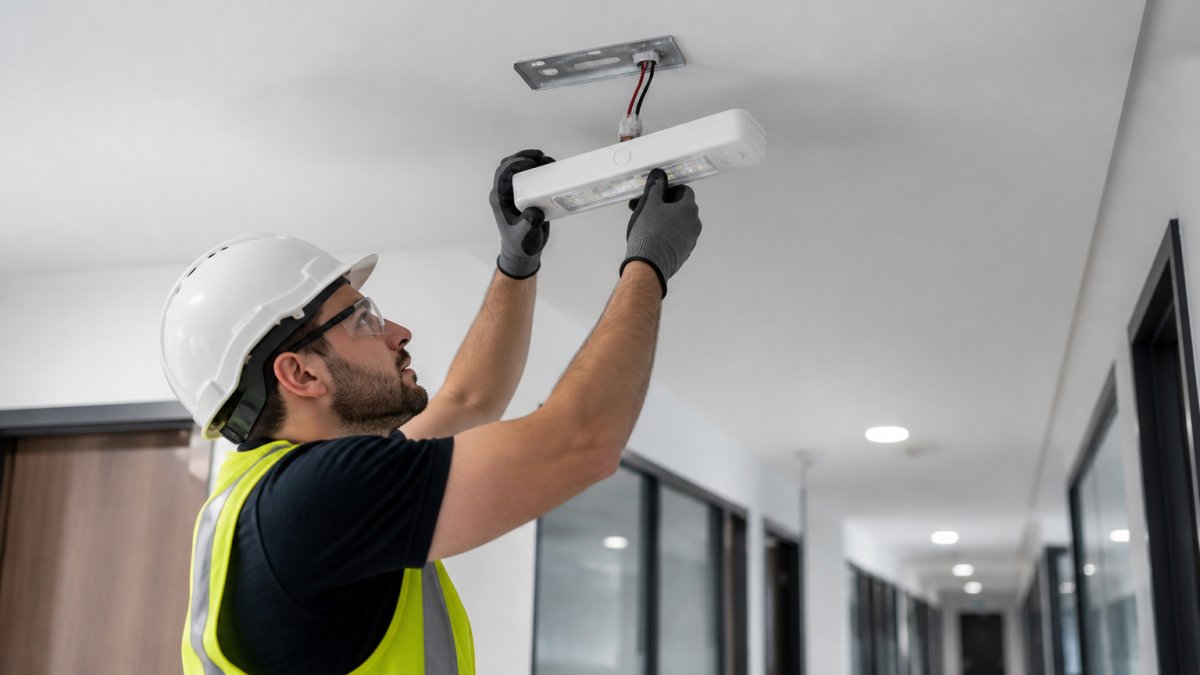
Basic Maintenance Tasks
Maintenance is straightforward but essential. Every month, test activation by switching off mains power to the light for 10-30 seconds. The light should illuminate immediately and brightly.
Every six months, clean the light lens with a soft, dry cloth. Dust accumulation reduces light output and makes the exit route less visible. In dusty environments like workshops or warehouses, clean more frequently.
Annually, perform a full battery test by running the light on battery power for its rated duration (typically 1-3 hours). Record the test date and results.
If a light fails a test, don’t ignore it. A failed light is a liability, it may not function during an actual emergency. Replace or repair it promptly.
Common Issues and Troubleshooting
Several problems can affect LED emergency lighting performance. Recognising these issues and understanding basic fixes helps you maintain a reliable system.
Light fails to activate when power is cut. This is the most serious fault. First, check that the light is switched on at the wall.
Light activates but is very dim. Dim illumination usually indicates a weak battery.
Light flickers or pulses. Flickering can indicate a loose connection between the battery and the light circuit.
Light stays on all the time, even though mains power is available. This suggests the relay that detects mains power failure is stuck.
When troubleshooting, always prioritise safety. If you’re unsure about any aspect of your LED emergency lighting system, consult a qualified electrician.
LED emergency lighting is a practical investment in safety and compliance. Whether you’re installing a single light in a domestic hallway or upgrading emergency systems across a commercial building, understanding the types available, the features that matter, and the maintenance required ensures your system works reliably when needed. Regular testing and prompt replacement of failed components are the keys to a dependable emergency lighting system that protects occupants and meets Building Regulations. For help selecting the right LED emergency lights for your property or business, browse Ledlam’s range of lighting solutions and electrical accessories, or contact our team for tailored advice.
Frequently Asked Questions
What is the difference between maintained and non-maintained emergency lighting?
Maintained emergency lights stay on continuously during normal operation, powered by the mains supply, and switch to battery backup during a power cut. Non-maintained emergency lights only activate when mains power fails. Maintained lights are better for areas where you need constant visibility (like corridors and stairwells), whilst non-maintained lights suit spaces where emergency exit routes only need illumination during an outage. Both types meet UK safety standards when correctly installed and tested.
How long must LED emergency lights stay on during a power failure?
UK regulations require emergency lighting to remain operational for a minimum of three hours during a power failure in most commercial and public buildings. The exact duration depends on your building’s use and occupancy. Residential properties have different requirements. Your LED emergency light’s battery capacity determines how long it will actually run. Check the product specifications and your building’s fire safety risk assessment to confirm the duration you need for your space.
Do LED emergency lights require regular testing?
Yes. UK law requires emergency lighting systems to be tested regularly. Monthly function tests (checking that lights activate and illuminate properly) and annual full-duration tests (running the system on battery for its full rated time) are standard practice. Some buildings may need more frequent testing depending on their risk assessment. Testing records must be kept and made available to fire safety inspectors. Ledlam can help you source reliable LED emergency lights designed for regular testing and maintenance.
How often should emergency light batteries be replaced?
Emergency-light battery life varies depending on the battery type, fitting, operating conditions and manufacturer. Batteries should be checked through the regular emergency-lighting test programme and replaced if they can no longer achieve the required rated duration. Always use the replacement battery specified by the manufacturer.