













How to Wire a Plug for a Heavy Duty Appliance
Last Updated: October 29, 2026
Quick Summary
To wire a plug for a heavy duty appliance, first check the appliance rating label, then match the cable size and fuse to the load. Connect the brown live wire to L, the blue neutral to N and the green and yellow earth to E, then tighten every terminal and cable grip firmly.
- Check the appliance rating label for watts or amps before starting.
- Choose a fuse just above the running current, never higher than the cable can carry.
- Connect brown to L, blue to N, and green and yellow to E.
- Ensure the outer sheath is clamped firmly under the cable grip.
- Use a fused connection unit for high-load or permanently fixed appliances.
Table of Contents
- Why Heavy Duty Appliances Need Special Attention
- Tools Needed for Plug Wiring
- Choosing the Correct Fuse Rating for Appliances
- Step-by-Step: How to Wire a BS 1363 Plug
- When a Plug Is Not Enough: Using a Fused Connection Unit
- Safety Checks and Common Mistakes to Avoid
- Booking Your Electrical Supplies and Next Steps
- Frequently Asked Questions
Why Heavy Duty Appliances Need Special Attention
Learning how to wire a plug for a heavy duty appliance is not the same job as wiring a table lamp. Appliances such as electric cookers, showers, electric heaters and large workshop tools draw far more current, so the plug, cable and fuse all have to be matched to the load. Getting this wrong can cause overheating, melted terminals or a fire.
Always check the appliance rating label before you start. It shows the power in watts or the current in amps. Use that figure to pick the right cable size and fuse.
Before you begin, be clear about what is a legal requirement and what is good practice. Under the Electricity at Work Regulations 1989, electrical work must be carried out safely, and fixed installations are covered by BS 7671, the IET Wiring Regulations. Plug wiring for a portable appliance sits within general safe-working duties, but the rules that apply to your premises can differ, so check the manufacturer’s instructions and seek advice from a qualified electrician where you are unsure.
Watch out: never fit a 13A plug to a heavy load without first checking the cable size and fuse rating match the appliance.
Tools Needed for Plug Wiring
You do not need much to wire a plug properly, but the right tools make a clean, safe job much easier. Have these ready before you start:
- Cable stripper or sharp knife for the outer sheath
- Insulated electrical screwdriver, ideally a small flat-head
- Wire strippers sized for the conductor thickness
- Multimeter or voltage tester to confirm the supply is off
- Replacement BS 1363 plug with the correct fuse fitted
- Cable of the correct size for the appliance load
Ledlam stocks a range of electrical accessories and fittings. For a related job, you can browse our electrical accessories on ledlam.lighting and check the current stock and specification on the product page before ordering.
Choosing the Correct Fuse Rating for Appliances
The fuse in a plug protects the cable, not the appliance. Its rating should be just above the normal running current of the appliance, and never higher than the cable can safely carry.
Common UK plug fuse ratings are 3A, 5A and 13A. Always check the appliance manufacturer’s instructions for the correct fuse rating.
Use the wattage on the appliance label and divide by the mains voltage (230V in the UK) to find the current. For example, a 2,300W heater draws about note that 10A fuses are non-standard in domestic plugs, so it needs a 13A fuse and a suitably rated cable.
Watch out: a fuse that is too high will not blow in time to protect the cable. Never replace a fuse with a higher-rated one to stop it blowing.
The table below summarises the common plug fuse ratings the article covers and what each is typically used for.
| Fuse rating | Typical use | Key point |
|---|---|---|
| 3A | Low-power appliances | Check manufacturer’s instructions |
| 5A | Mid-range appliances | Check manufacturer’s instructions |
| 13A | Higher-load appliances | Needs a suitably rated cable |
Step-by-Step: How to Wire a BS 1363 Plug
Work through these steps in order. Make sure the appliance is unplugged and the circuit is switched off before you touch any wires.
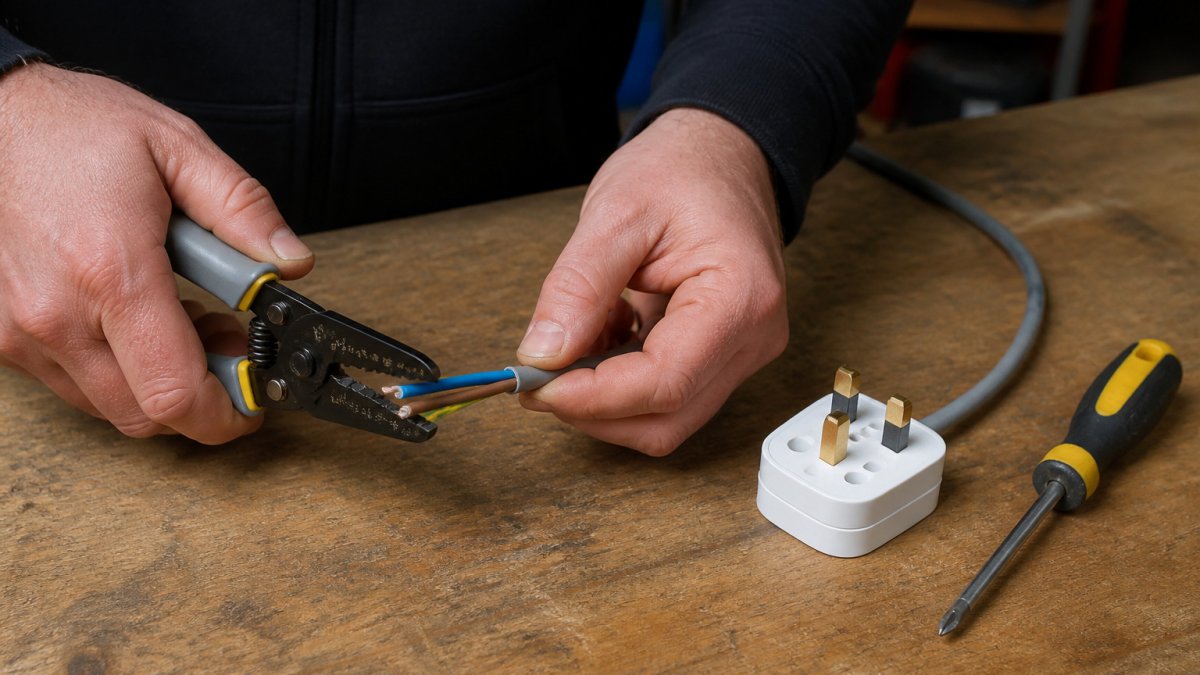
Preparing the Cable and Stripping the Outer Sheath
Start by cutting the cable to the correct length, leaving enough slack for the plug to be opened and closed without strain. Carefully strip about 40mm of the outer sheath with a cable stripper. Take care not to nick the insulation of the inner conductors.
Once the sheath is off, check the three inner cores. The brown wire is live, the blue wire is neutral and the green and yellow striped wire is earth. Trim the cores to fit the plug terminals and strip about 8mm of insulation from each end.
Make sure the outer sheath sits fully under the cable grip clamp so the cable cannot be pulled out of the terminals.
Terminating the Live, Neutral and Earth Conductors
Connect each conductor to the matching terminal:
- Connect the brown live wire to the terminal marked L.
- Connect the blue neutral wire to the terminal marked N.
- Connect the green and yellow earth wire to the terminal marked E or the earth symbol.
Tighten each screw firmly so no bare copper is visible outside the terminal, and no loose strands escape. Fit the correct fuse for the appliance, close the plug cover and tighten the cable grip so it holds the outer sheath. Properly secured connections ensure the safety of your installation, though any underlying issues with your electrical system may require the expertise of a certified house rewiring professional to address.
Before plugging in, check your work. Make sure no strands touch another terminal, the cable grip is tight, and the fuse is correct. The terminal screws should be tight enough that the wires cannot be pulled free.
When a Plug Is Not Enough: Using a Fused Connection Unit
Some heavy duty appliances should not be run from a standard plug and socket at all. Fixed appliances such as electric showers, cookers and some heaters are normally connected directly to the supply through a fused connection unit, often called an FCU or a fused spur.
A fused connection unit gives the appliance a dedicated, switched and fused supply. It is usually the right choice where the load is high or the appliance is permanently installed. Installing or altering fixed wiring should be done by a competent person, and requirements vary by premises, so check with your local building control office.
Use an FCU when the appliance manufacturer specifies a fixed connection, or when the load would overload a standard socket outlet.
Safety Checks and Common Mistakes to Avoid
A quick safety check before and after the job can prevent most faults. Work through this list:
- Appliance and circuit switched off and isolated before work starts
- Cable size matches the appliance load
- Fuse rating is correct and not oversized
- Each conductor is on the right terminal (L, N, E)
- No loose strands outside the terminals
- Cable grip clamps the outer sheath firmly
- Plug is undamaged and the cover closes properly
Common mistakes include swapping live and neutral, fitting an oversized fuse, leaving the outer sheath unsecured under the grip, and using a plug on a load it was never designed to carry. Any of these can cause overheating or fire.
If the plug, cable or socket feels hot, smells of burning, or the fuse blows repeatedly, stop using the appliance and get it checked by a qualified electrician.
Booking Your Electrical Supplies and Next Steps
Once you know what you need, gather the right cable, plug, fuse and fittings before you start. Ledlam supplies electrical accessories, switches, sockets and cables from our Basildon Market shop and online.
Visit ledlam.lighting to check current stock and specifications, or come to our Basildon Market store to talk through your job. For fixed installations, a qualified electrician should carry out the work and any certification required.
Frequently Asked Questions
What is the maximum wattage for a standard 13A UK plug?
A standard 13A plug is rated for up to 3,000 watts at 230 volts, because current is the limiting factor: 13 amps multiplied by 230 volts gives roughly 2,990 watts. The rating is set by the fuse inside the plug and by the cable it is fitted to. For heavy duty appliances drawing close to this limit, a dedicated circuit or a fused connection unit may be a safer choice, and the appliance manual should always be checked first.
Do heavy duty appliances require a fused spur instead of a plug?
Not always. Many heavy duty appliances, such as electric cookers or larger water heaters, are wired directly to a circuit through a fused connection unit or cooker switch rather than a plug. Whether a plug is acceptable depends on the appliance’s rated current, the socket circuit and the manufacturer’s instructions. Where the appliance is permanently connected or its load is high, a fused connection unit is usually the more suitable arrangement.
How do I know which fuse rating to use for my appliance?
Check the rating label on the appliance or in its manual, which lists power in watts. Divide the wattage by 230 to estimate current in amps, then select the next standard fuse size above that figure, such as 5A, note that 10A fuses are non-standard in domestic plugs or 13A. Never fit a higher fuse to stop nuisance tripping, because the cable could overheat. If in doubt, consult a qualified electrician.
Is it legal to wire my own plug in the UK?
There is no law banning you from wiring a plug yourself in England, Wales or Scotland, but the work must be done correctly and to the relevant British Standard, BS 1363. Plugs and cables must be fitted to the right rating and checked before use. Work on fixed household wiring, by contrast, is subject to Building Regulations and is normally carried out by a competent person; check with your local building control office for requirements that apply to your premises.
